

Susan Simensky Bietila is a member of the World War 3 Illustrated collective, and her comics and art have appeared in books like Wobblies! A Graphic History of the Industrial Workers of the World and magazines like The Nation. She was one of the editors of the pioneering, iconic feminist newspaper RAT. Her new book, Front Lines, which came out this year from PM Press is one part memoir, one part collection of artwork, but it is really a story of activism and community.
This is Bietila’s story, and like her artwork, and her long career as an artist working in many media, it is truly singular. But this book tells the story of her life as a part of many different communities. It is the story of how activist movements that many see as isolated and unconnected are in fact deeply intertwined. This is a book about art and activism, that talks as much about other people as it does herself, because that is how Bietila sees the world.
It is how she has always perceived the world. Late in the book Bietila quotes Paulo Freire, the great educator and philosopher who asked his students to “analyze personal experience and connect it to the causality of oppression. Collective power comes from putting personal experience into the social context and revealing the root causes we must overturn, together.” It’s a good way to sum up how Bietila thinks about the world and about the intention of the book.
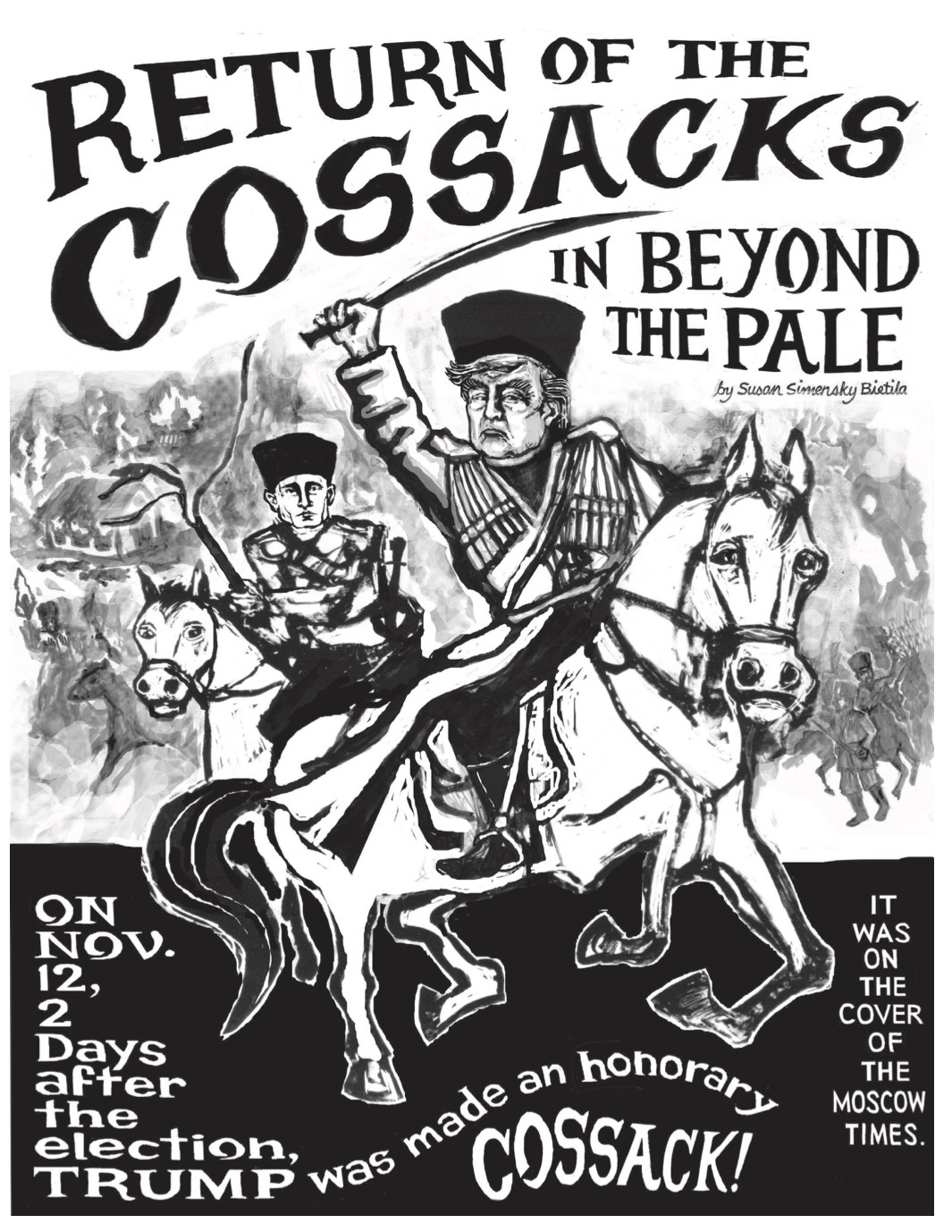
Early on we read one of Bietila’s more recent comics, from 2017’s World War 3 Illustrated #48, “Return of the Cossacks.” The eight page comic covers a lot of both family history and the history of the US and Russia in ways that ties them into contemporary events. It’s a remarkable comic and stands as one of, if not Bietila’s very best, comics. In a few short pages she designed each page layout to be dense but readable, tracing her interest in social justice to her childhood, the influence of her parents and grandparents, the stories she was raised with about her family escaping the pogroms of Russia for the relative safety of the United States, and the unwelcoming politics her family found in the 1920s.
Coming of age in the 1960s, Bietila became politically aware in 1964 when she worked at a camp the summer before college and learned about the students working in the Civil Rights movement, that the U.S. was at war, and that boys her age were fleeing to Canada. In the years that followed at Brooklyn College and working in New York, Bietila was involved with the Free Speech Movement and the Students for a Democratic Society. She protested HUAC hearings and made masks for the Bread and Puppet Theater. She changed her major from math to studio art, not simply out of a desire to make art — she talks about what art classes and the politics around art was like then — but that like many, she doubted the possibility of pure research during the Cold War. Aware of the regrets of Einstein, Oppenheimer, and others, she sought to pursue a path that didn’t involve working in support of the military machine.
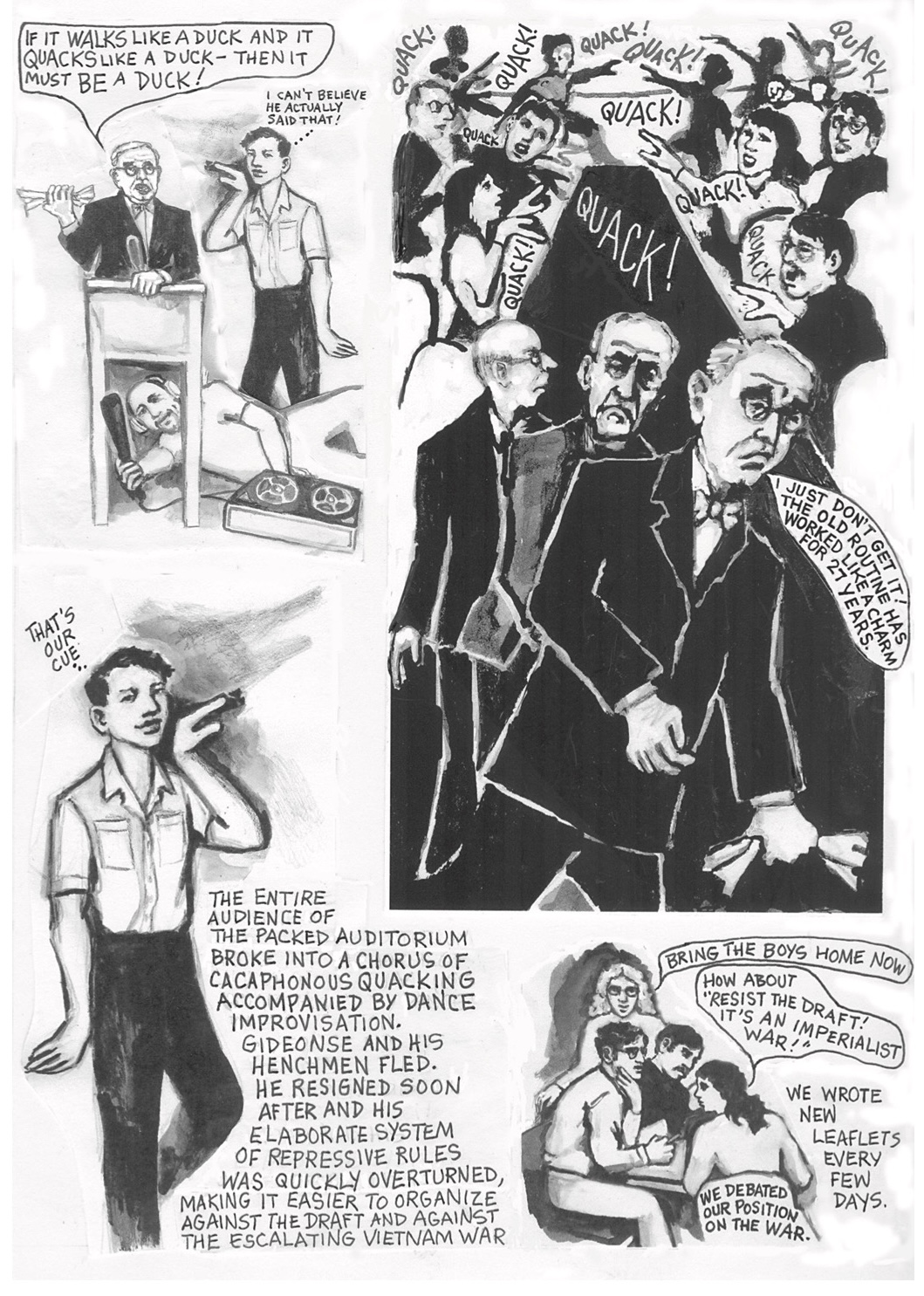 Bietila details her time at Brooklyn College and the Free Speech Movement in a comic included here from 2007 titled “Toppling Tyrants 101” centering around a sit-in on campus where the police arrested and beat students. Bietila was not at the protest, but still dragged from class by the cops. The result was students and professors who opposed the protests stepping up. Students sat down and blocked the paddy wagons, preventing them from moving. The college shut down for three days. All charges against the students were dropped, and the school’s rules around free speech were changed.
Bietila makes it clear that this was a victory on every level, one that was only possible through engagement and community. It inspired her and had a deep influence on what she thinks about activism and reaching people. But in a postscript at the end of the comic, she states that in returning to campus to research the story, the institutional memory of what happened was rather different.
The book begins in New York, where Bietila grew up and attended college, but much of the book is about her time in Wisconsin where she’s spent most of her adult life. Much of her work has been in the service of the local community. People like to quote “think globally act locally,” but Bietila’s life and art is an example of someone who did just that. Talking about her artwork, her activism, her decades-long career as a nurse, Bietila writes about herself and her work, but she’s also writing about her community, and how she sought to live a life of service. — one that connects antiwar protestors to the environmental movement, Native American activists to the WTO protests in Seattle, the 2011 Wisconsin uprising to the years-long protests against ICE and immigration policy.
In one of her comics, Bietila quotes Aboriginal activists from Queensland, Australia: “If you have come here to help me, you are wasting your time. But if you have come here because your liberation is bound up with mine, let us work together.” I keep thinking that this is Bietila’s statement of purpose. Not for this book, but how she has lived her life. This is why while there’s a vast array of great comics work from her, why there is a lot of great posters and images, she includes lots of work where she was one of the people involved, or work that isn’t hers. There are photographs of protests involving large puppets, masks, banners that are not “hers” but she was part of the “we” who made them. It’s a document of something more than herself. She was a part of these protests and actions and communities, and her story is part of their story, and vice versa.
That is a moving and thoughtful aspect of the book, but I also wish that there was more examples of Bietila’s work, and documentation of it — the work made because of budget constraints, because of a lack of materials, work created for certain kinds of protests and why they couldn’t use similar older work. Not a how-to guide, but more insight and detail. There is some in the book, but I wanted more.
Bietila ends the book by informing readers that her husband died a few years ago, but that she and her children and grandchildren continue the work, concluding the book by saying, “I look forward to new and creative forms of mutual aid and to ever-broadening circles of resistance in these extraordinary times. We will win.”
The post Front Lines: A Lifetime of Drawing Resistance appeared first on The Comics Journal.


 Hello, my name is Jack Sparrow. I'm a 50 year old self-employed Pirate from the Caribbean.
No comments:
Post a Comment