

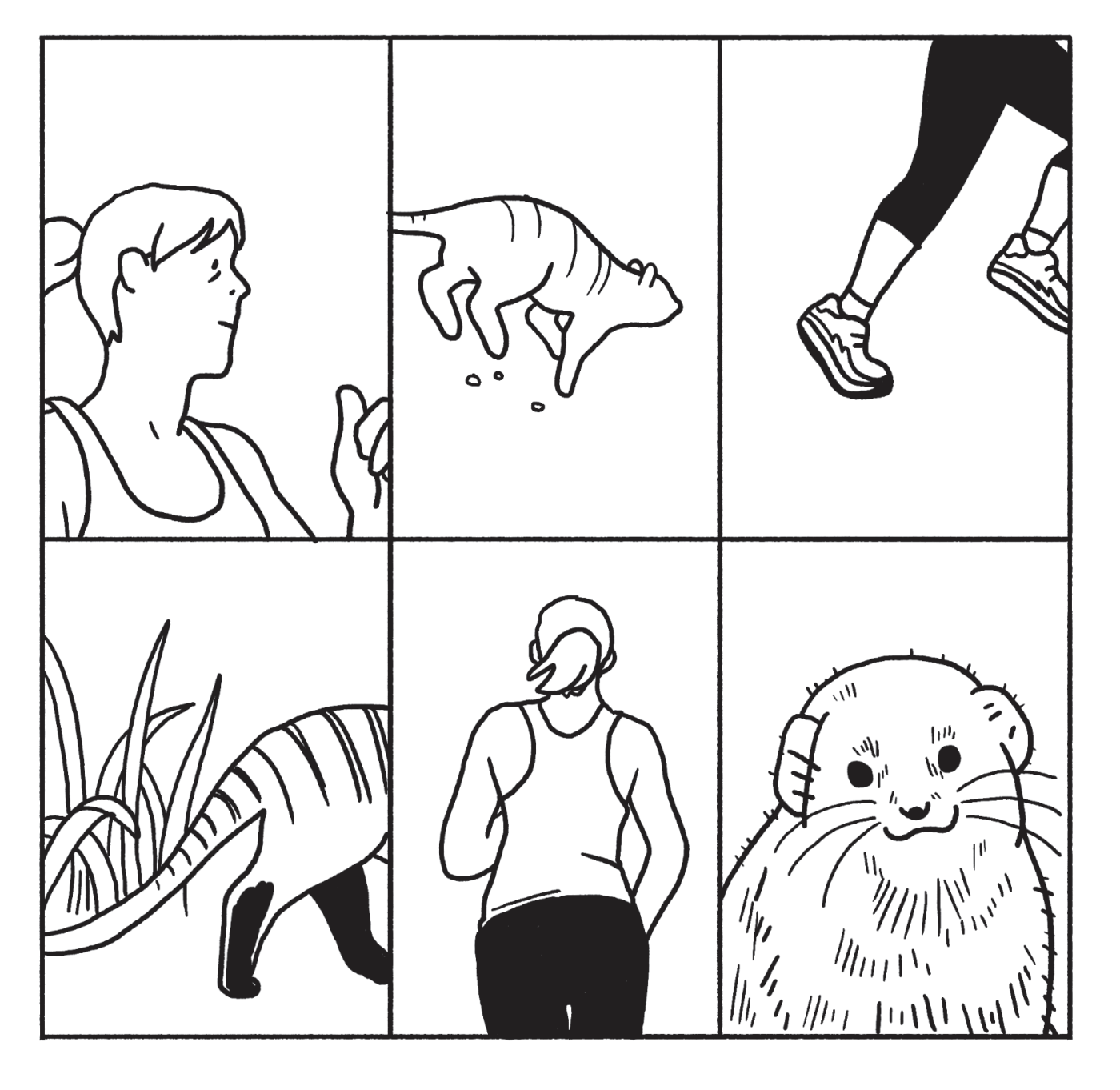
When Julia discovers that a pest has destroyed her garden, she is convinced that the culprit is a mongoose, much to the surprise and disbelief of her friends and family members. No one has heard of a mongoose destroying gardens, let alone living in the vicinity. But Julia perseveres with her hunch, spending an evening researching the animal. She had promised her dearly departed Paulo that she would look after his garden, a promise tied to living a healthier life. But although Paulo is mentioned at the beginning of the volume, he does not appear until page 70, because the story is not about him but Julia, the bereaved, and The Mongoose is the story of her intimate journey of coming to terms with his passing.
Julia is a teacher on extended sick leave. She lives in her late grandmother’s beach house in a distant suburb of Lisbon. It was also the place that she and Paulo called home. Her younger brother Joel has recently had some troubles of his own. He lost his job, his apartment and his girlfriend, but he moves in with his sister because he doesn’t want her to be alone, and he relishes reliving happy childhood moments with her at their grandmother’s house. Joel is a 37-year-old game designer who spends most of his time on the couch playing video games. Julia tells people that she and her brother don’t really talk.
Although Joel is kind to Julia, she can barely conceal her annoyance with him. Her answers are short and at times sarcastic. She has a support network, but she keeps them at arm’s length, saying she is fine without offering any details. Her mother, who is both understanding and an advocate of tough love, in equal measures, keeps insisting that Julia see a therapist.
Grieving is a deeply personal, nonlinear experience. There are no fixed stages in grief, but some feelings are common — anger, confusion, sadness and mental fatigue. But grieving is ultimately interior, and here lies the obvious question: How does a graphic novelist show the psychological states of mourning without relying strictly on verbal cues or clichéd actions?
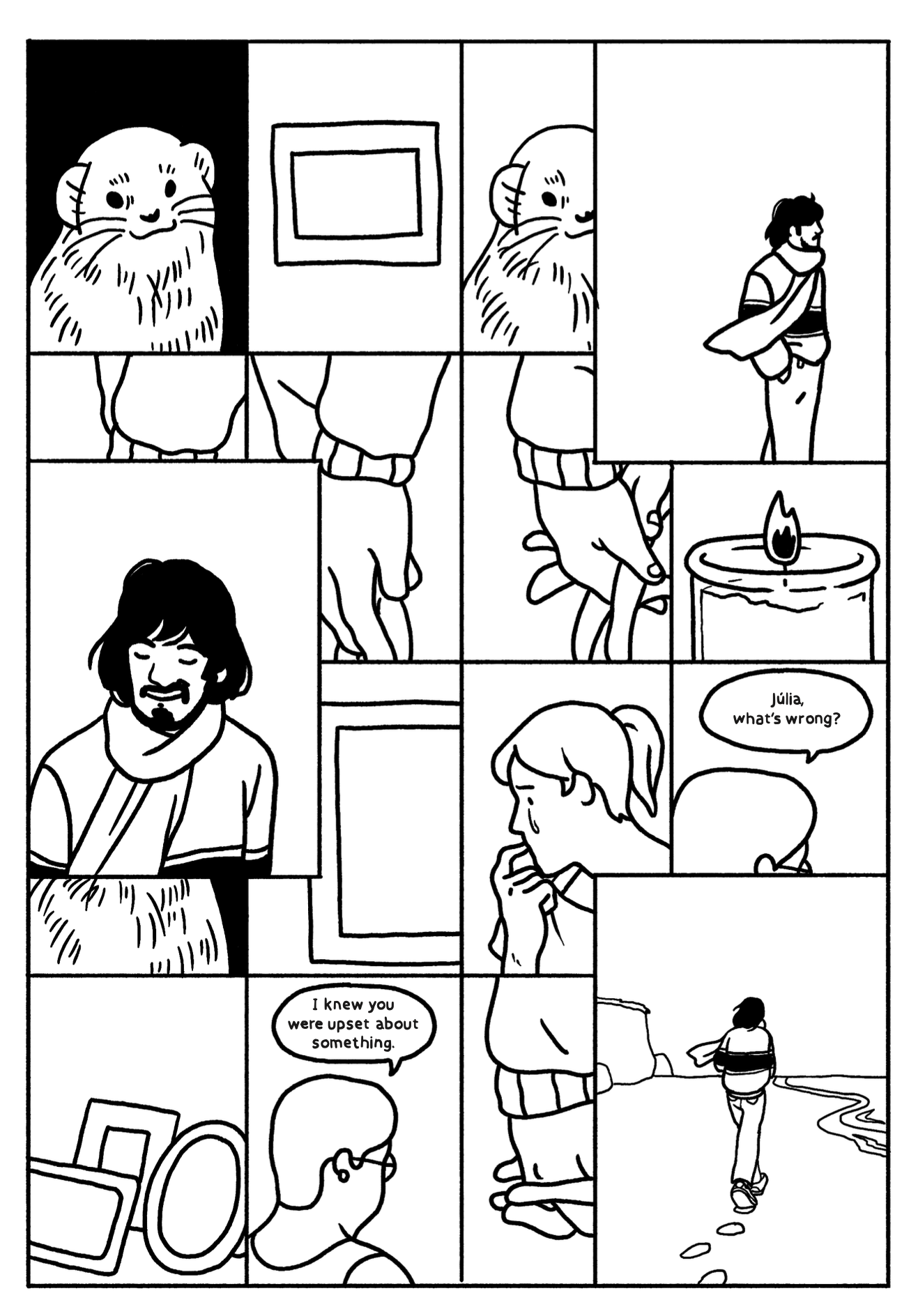
Joana Mosi, an award-winning artist, masterfully shows Julia’s thoughts, feelings and dreams through her drawings. She demonstrates both admirable restraint and subtlety in her work. Julia’s fatigue is shown through single lines under her eyes, her slouched posture and a hand on her forehead. Mosi is a minimalist, and her art is enjoyably clean, without any superfluous detail. Faces are often not drawn in, but the character’s reaction is often seen in the posture, hand gestures or a tilt of the head. This graphic novel shows experience and expertise as an artist. I’m such a fan of her style.
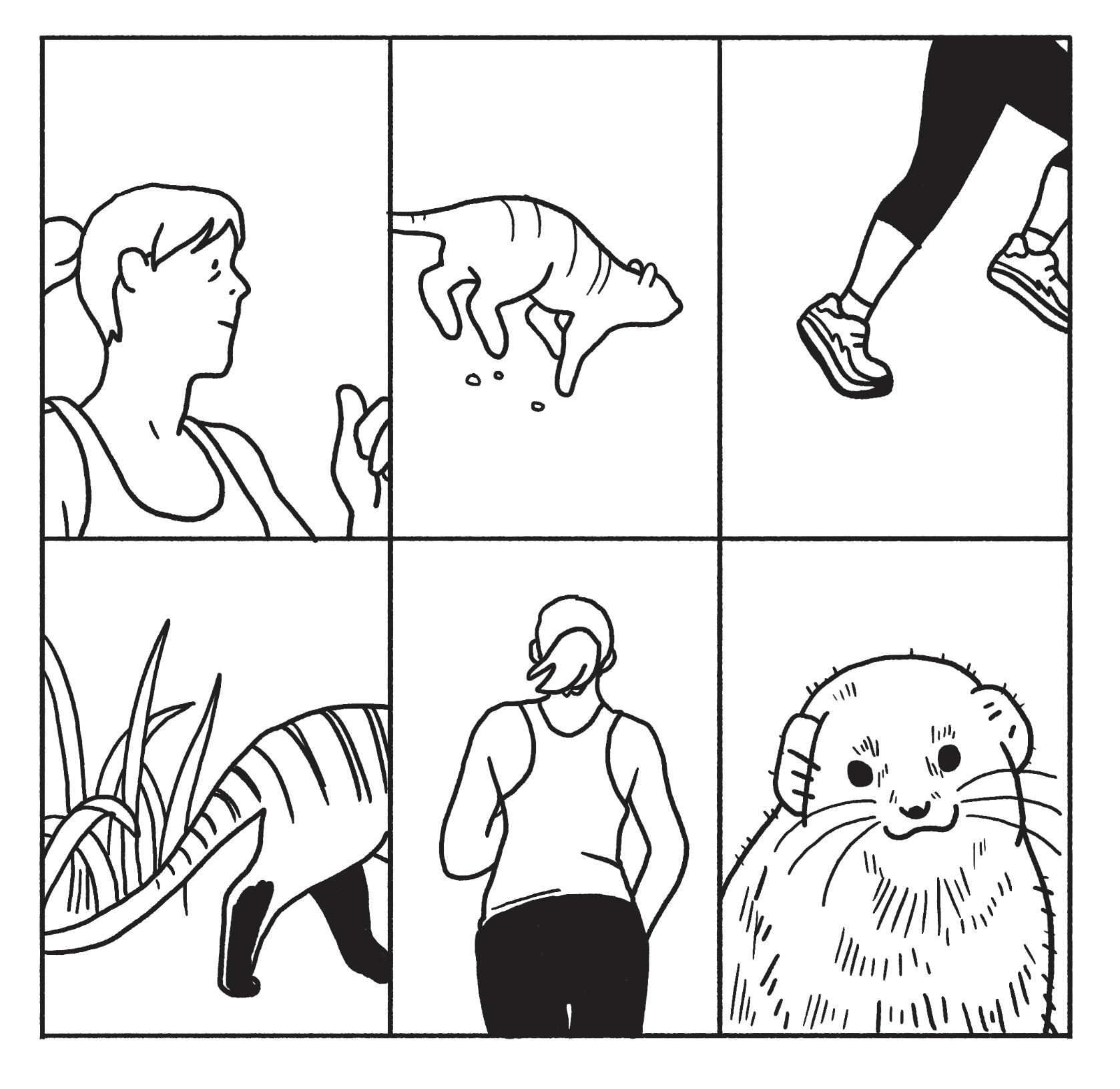
 But the real magic in The Mongoose is its use of symbolism. In general, the mongoose is known for its agility and aggressiveness, and as the reader learns, it will also take on snakes. The mongoose repeatedly appears in Julia’s thoughts, sometimes cute and sometimes menacing, and she later tells the therapist that it causes her great anxiety. She even fears that it might get into her house. The stuffed animal belonging to her cousin’s children also takes on mongoose traits. But Julia is slow to take any action to get rid of the animal she thinks destroyed Paulo’s garden. She merely drifts from place to place, talking about what she should do. Julia’s trepidation toward the mongoose feels like a way to avoid facing Paulo’s death.
Mosi uses other symbols to great effect in Julia’s psychological journey, such as the shell she found with Paulo during a walk on a nearby beach — a setting that recurs throughout the story. Multiple times the reader sees empty picture frames and the boxes Julia uses to pack up her dearly departed’s belongings. In addition, many panels are devoted to the garden overgrown with weeds, or a single worm writhing in the soil. So many objects in Julia’s life lead back to Paulo. But alongside these reminders is the mongoose.
Mosi also relies on the normative character of Joel to show Julia’s disproportionate reactions to everyday situations. When Joel and Julia are returning from a family birthday party, Julia talks about her cousin Otilia, “The nerve! Who does she think she is?” Julia is angered because her cousin played George Harrison’s “My Sweet Lord,” one of Paulo’s favorite songs. Joel’s reaction puts her anger into perspective, “You know, I think it was quite nice of her to play that song after the toast, actually. … She’s trying, okay.”
In another instance, after a disappointing job interview, Joel is informed that the company isn't interested in the types of educational games he designed. They're looking for something more addictive, something people would play in a supermarket line. After several major setbacks in his own life, Joel decides he needs a change. Before moving on, he attempts to surprise his sister by fixing up the garden. When Julia discovers what he is doing, she mentions the mongoose again, and Joel calls her out in a series of 11 panels.
As the book progresses and Julia advances further in her grieving, the reader sees more panels of Paulo, but he is always looking down or away. It isn’t until Julia is able to face her grief and actually cry that we finally see Paulo’s face. Pop culture tells us that upon death, our loved ones weep immediately, but that demonstrative sorrow sometimes comes much later in the grieving process.
Capturing grief in all its subtleties is a feat in itself. Few people would dare to address something that complex, but Mosi has succeeded brilliantly, and from my own experience, this is an accurate portrayal. Although this subject matter might not be everyone’s cup of tea, this story will be helpful to anyone who is trying to understand the intricacies of loss.

My only criticism was the video game of a little girl watering her garden that often enters Julia’s thoughts. This is also the video game Joel is playing. It fits the theme of gardening and features a mongoose and a snake, but its significance was lost on me. Was it Julia just trying to think of anything other than the inevitable? I couldn’t be sure.
That aside, The Mongoose is a beautiful meditation on love and loss. Everyone has places, songs, and small keepsakes that instantly bring a loved one to mind, and Mosi shows Julia moving through those memories with a tenderness that never feels overstated. The author likewise balances Julie’s inner journey — revealed through her dreams, daydreams, and the physical manifestations of her grief, such as anger, annoyance, apathy, and distraction — with precise, understated detail that keeps the narrative grounded. The author’s keen attention to detail and her nuanced rendering of body language reveal a mastery shaped by years of experience.
The post The Mongoose appeared first on The Comics Journal.


 Hello, my name is Jack Sparrow. I'm a 50 year old self-employed Pirate from the Caribbean.
No comments:
Post a Comment