

By 1962, fans of Edgar Rice Burroughs’ Tarzan waged a rebellion against artist Jesse Marsh. Marsh helmed the character for the Dell-Western iteration in 1948, drawing over one hundred issues of Tarzan and frequent backups for Korak, Son of Tarzan up until his retirement. For the younger readers, he was the only Tarzan artist they had ever known, yet the outcry appeared almost unanimous. Not only did Marsh receive the rancor of Burroughsian sycophants for perceived “disrespect” of the source material, casual readers also soured on his antiquated, static style, frequent anatomical errors, and drab action sequences.
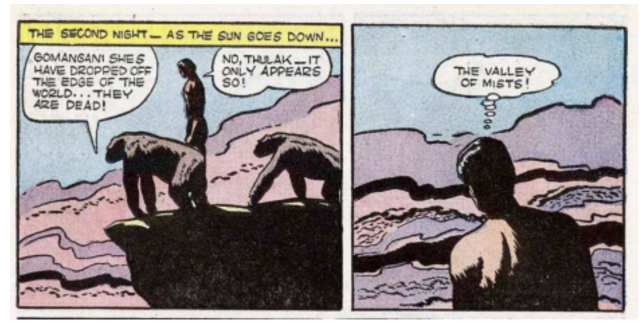
It’s true that Marsh’s health was in rapid decline. His diminishing eyesight from a long battle with diabetes only served to further simplify his style, mostly defined by bold colors, strong chiaroscuro, and limited linework. The Burroughs estate went so far as to lobby for Marsh’s removal along with the fans.1 They wanted a more “sophisticated artist” in charge of representing the franchise, perhaps implicitly calling to mind the earlier work of Burne Hogarth, whose robust (and physiologically accurate) character designs quickly became the franchise’s most iconic iteration. The editorial team kept strong against such pressure, but in 1965, the estate got their wish, and Marsh’s pupil Russ Manning took over art responsibilities for all Tarzan stories. Marsh passed away a year later.
The modern reader can perhaps see the fans’ point. Of the many runs on the character, Marsh’s does not rank near Hogarth’s in the ‘40s or Joe Kubert’s seminal DC work in the ‘70s. Hogarth, whose Dynamic Drawing Series books are still the text on action comic anatomy, drew Tarzan as the muscle-bound beauty from the Johnny Weismuller films, an adonis bounding through endless foliage and exotic locales. His animal companions are exclusively gigantic: gorillas, elephants and mountain lions abound. His adversaries: evil African witch doctors, fantastical voodoo-men and fanatical dictators. Africa is a lush, Amazonian playground for the Ape Man, and audiences delight in its glory as much as Tarzan’s beauty. Kubert’s approach is terse and action heavy. He holds to some of Marsh’s shadowy compositions, but is aligned with the Hogarth school’s emphasis on bodies in action. He also holds closer to the source material transcribing the fantastical imagery and psychedelic conspiracies that colored the later sequels’ narratives.
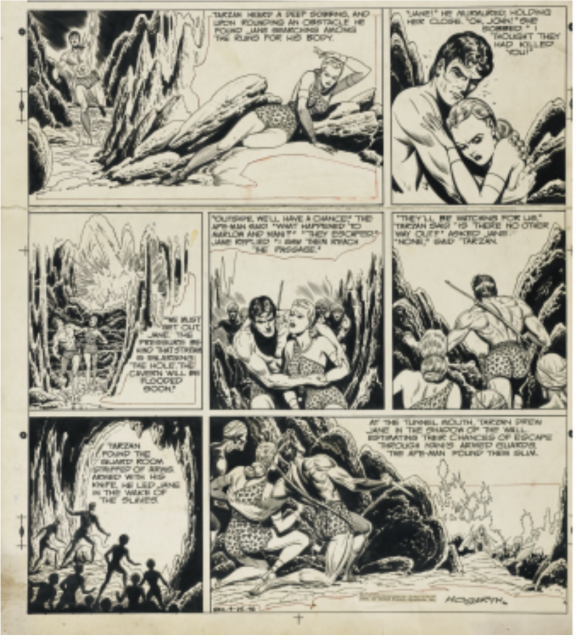
Hogarth and Kubert drew action comics, first and foremost. They are filled with intrigue, suspenseful action, seductive bodies; none of which Marsh’s iteration can boast. Even Manning’s work on the character soared leagues ahead of his mentor in melodrama and fantastical imagery.
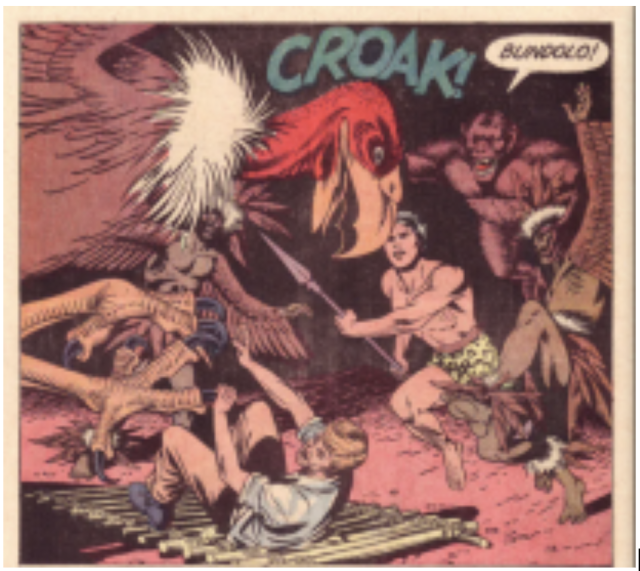
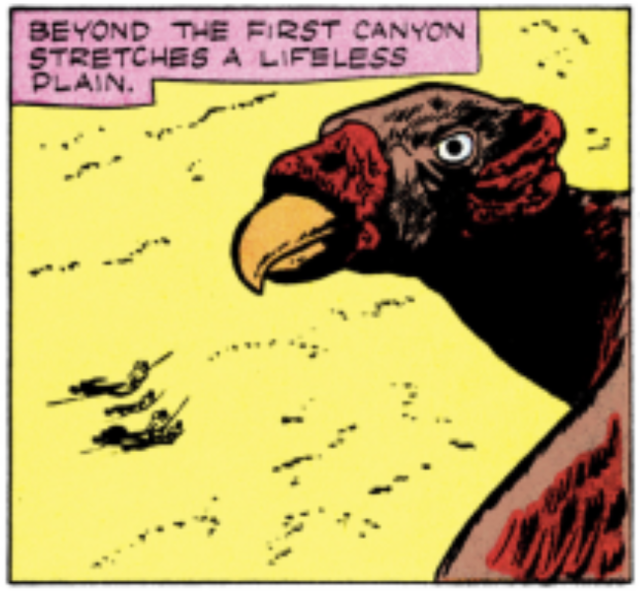
Their animal designs render the difference: In Korak, Son of Tarzan, the gang tussles with hungry vultures sheltering in a subterranean city. Manning draws the creature as a towering, monstrous villain with rabid beak and beating wings. In a similar sequence in the main book, Marsh’s heroes are stalked by maleficent buzzards eager for human flesh. Instead of drawing a ferocious creature trembling for the pounce, the vulture simply glares at the reader against a shapeless desert, more from ennui than ravenous hunger.
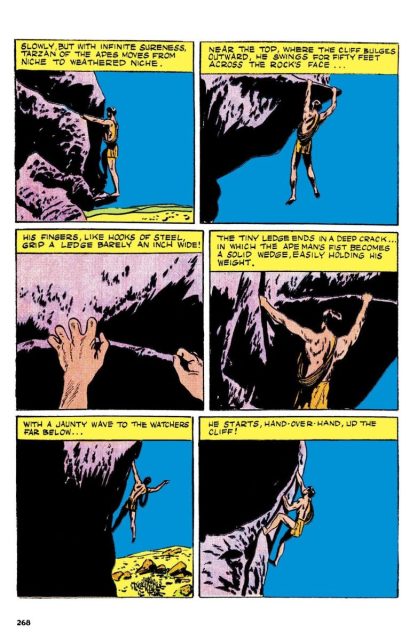
Manning recalls an early piece of advice Marsh gave him: What matters most is boldness, he proclaims, which can be demystified a little into clarity of subject and simplicity of background. His peers draw Tarzan center-frame almost exclusively, the jungle around him boundless and filled with life both modern and prehistoric, while he puts the hero far in the background, or to the right, in silhouette, a sky in dull blues and grays loping over him. He appreciates shadow and darkness as the essential aspects of any sequence. No wonder a slew of issues complete their climaxes in caves or river-bottoms.
In Hogarth, backdrops are replete with hiding animals and mysterious flora in the far frame. There is a sense of movement and abundance that creates high drama in the expository panels. Manning, too, has a love of megafauna: the mammoth-like elephants and alien giraffes stalk the earth in large flocks, where Tarzan is the dwarfish but cunning survivor. Marsh’s biosphere is comparatively monocultural. Animals hunt alone. Apes are often shockingly person-like, if only long enough to look morose, or at least irked, at an empty expanse.
His negation of melodrama can be difficult to examine. Marsh was a famously quick artist. An issue of Tarzan, reportedly, took no longer than a weekend. According to Manning, Marsh did not believe a cartoonist should labor excessively over a single panel, or even a page.
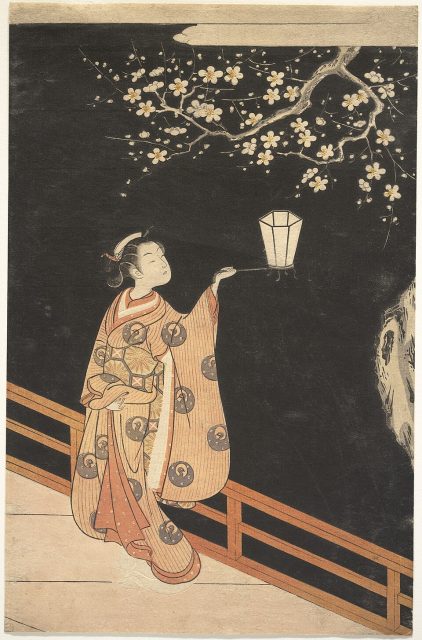
Night by Harunobu
Dan Nadel rightly points out Marsh’s study of ukiyo-e woodblocks.3.[/efn_note] Their sharp, figurative style is as close an ancestor for his idiosyncrasies as we can get. Take the work of Harunobu, the first wood-block artist to paint in full color. Harunobu is most remembered for his elegiac portraits of courtesans and noblewomen. Though the depth of color is wider than his predecessors, what is most pronounced is the completeness of his shadows and night skies. The blacks are opaque and somber, even eerie, as in “Woman Admiring Plum Blossoms at Night,” where a woman’s lamp only illuminates the blossoms and their branch, while the rest of the night is undefined, severe. One can definitely see Marsh’s shadows in Harunobu. The world appears severed, emaciated under an encroaching darkness. In even the most impressionist works of the famous Hokusai, the viewer can feel that hidden sparseness and terror; what Edmond de Goncourt calls “drawings of the most absolute reality,”4 absolute because there appears no life outside the frame, or inside, drawings complete in their acceptance of apparent nothingness. “Absolute reality” can also be a mantra for Marsh, sans its religious connotation for Hokusai. During his tenure on Tarzan he worked exclusively with writer Gaylord DuBois. DuBois had been writing for Dell-Western since 1944, mostly on their western and frontiersman stories like Gene Autry and Roy Rogers. He was a practiced explorer and outdoorsman, which allowed his work an uncommon accuracy in rugged wilderness knowledge.
He befriended Marsh immediately, found a common temperament and interest in the natural world. Specifically, they shared an obsession with the African continent. Soon after the inception of the United Nations and the de jure termination of the 19th century colonial project, Africa seemed a realm born anew, ripe for possibility in research and fiction. Outside of the European yolk, tribes (at least according to the American layman) were now free to determine their own societies on the continent. The white poacher was a problem, but seemed puny in comparison to the massive population of natives and the megafauna’s magisterial power.
Together, Marsh and DuBois implemented new information about Africa into Tarzan. The effort is clearest on the social level. Compared to the voodoo men of Hogarth’s strip, Tarzan’s African companions are kind, sometimes ingenious and deeply moral. They make independent decisions and wrestle with the responsibility of political leadership. Tribal lines are confused and agitated; many of the more elaborate plots involve civil war or interfamily conflict, much like the chaos that erupted from post-colonial underdevelopment.
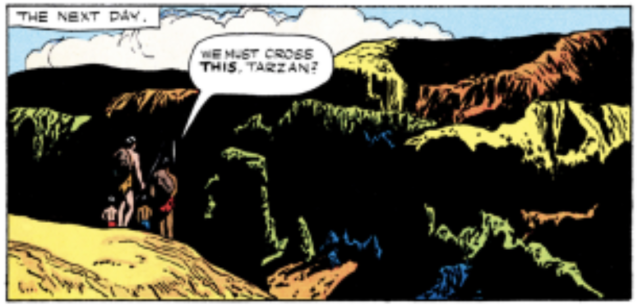
Just as distinct is the topography in the Dell-Western comics. Again, those before and after Marsh focused on the exoticism of Burroughs’ environments: lush jungles, ferocious deserts, those sensationally prehistoric aspects of Africa pulp fiction fell in love with. The vagaries of the “Safari,” the pulps frequently describe Africa as if glimpsed briefly from the backseat of an old jeep. Marsh is not immune to exoticism, but his research (as well as his precision in backdrop) complicates the old formulas. Marsh’s Africa is harsh, flat, colored in dull tans and greens. His ancient forests are replete with odd plants and creeping animals, but not in such close proximity as others describe. Forests have abundances of empty spaces, as they do in the real Africa. Creeks and rivers are not the verdant bodies of clean, blue water, but ordinary streams, made opaque and shadowy by murky runoff.
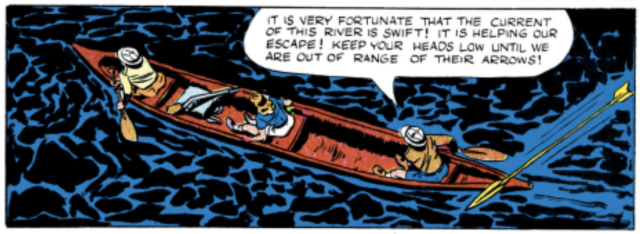
In fact, everything is shadowy in Marsh; it is perhaps the most notable difference between his style and others in action comics. His monochrome landscapes may appear never-ending, but when the frame tightens, much of the scene is under solid blacks. He rarely uses traditional shading methods. Instead, hold swaths of the frame are annihilated by shadow. The effect is most apparent in his cave-bound action sequences, but even in broad daylight, he prefers much of a given landscape completely obscured.
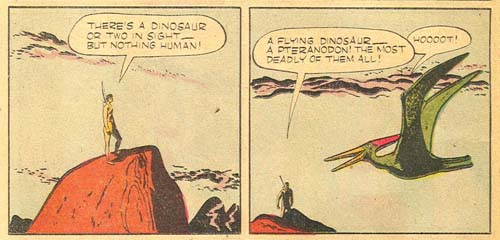
To say that Marsh’s Africa is obsessively accurate would be exaggeration. He is still a fantasy artist; the old Burroughsian death-cults make up most of the villains, and the geographic area of his stories never becomes clearer than “the jungles of Africa.” However, his landscapes deny an important myth around the continent. He does not draw Africa as a paradise. Far from it: the land is flat and cruel. The crabgrass hills and yellow fields are not enough to seduce us. Despite his screed against overworking a panel, he does take particular care in creature anatomy. Lions are drawn with realistic bloat, as are gorillas painstakingly related in their dreary, hunchback positions. There is nothing sexy about his giraffes, which he composes as long-necked donkeys, alone and hunted on the plains.
It is their aloneness that is most striking. Marsh does not draw animals in packs, much like he does not draw superabundant forests. The loping expanse of savannahs might have a single antelope or elephant on the horizon. There may, too, be a lion hunting on a prairie, but we will not see her cubs, her mate, or any other living creature. Marsh’s Africa goes in the opposite direction of Hogarth and Manning. He draws a stark, apocalyptic society on the bones of the exotic. It’s difficult to imagine Edgar Rice Burroughs setting his adventure series anywhere near such a wasteland, nor would a pulp-obsessed reader believe this is the “real” Africa.
In 1959, The Atlantic published an article called “The Vanishing Herds” by George Treichel. Treichel, a biogeographer who spent most of his time researching the West African landscapes most Tarzan artists use as their inspiration, warned general readers of the encroaching fauna collapse on the continent. Poachers had already been considered an ecological threat for decades, but the extent of industrialization in the region was virtually unreported in the west. A century of settler-colonial efforts crippled essential ecosystems, wiped out species, and desertified the plains in the east. Megafauna – elephants, giraffes, and rhinoceros – got the worst of the brunt. Treichel predicted that in one or two decades, “all [wild] large animals will be completely wiped out.”
Treichel’s article introduced much of the global populace to the emergency of African conservation. His work, among other landmark field reporters, spurred governments and global nonprofit associations to action. Of course, much of the damage was already done, and many of his predictions proved true.
Dell-Western’s Tarzan series premiered a decade before the article was published, and Marsh had already begun to hone in his stylistic eccentricities. But the Africa he and DuBois studied in order to craft the series was already in a critical state. English poachers in the late 19th and early 20th century depleted elephant populations well below the “threatened species” threshold. The colonies in Nigeria were not conservative in their extraction of rubber, palm oil, and lumber from the West’s forest, and the transition to a factory model only furthered the raising of important landforms and wild ecosystems.
Marsh’s minimalist Africa is only the truth. “Absolute reality” in Goncourt’s words, of a land stripped down to the bone. His Africa, robbed of its rampant biodiversity and towering beasts, is not the Africa of the early colonists’ time, or even of Edgar Rice Burroughs’ time. His is necessarily broken, captured in stretches of loneliness and shadow. His signature shadows can be explained by a sun no longer softened by tree cover, heat no longer dampened by a vast carbon sink. The animals, too, are sunscalded, and roam listless across the frame. The artist’s anti-melodrama may be explained by a harsh biome made harsher by colonial activity.
“The spell of old Africa will forever be broken,” concludes Treichel, “if the giraffe and wildebeests, zebras and gazelles…are allowed to vanish.” In Marsh’s Tarzan, that “spell” is a distant memory. To those of us reading in the 2020s, it is difficult to imagine those massive jungles as ever having existed. Treichel’s omens are optimistic compared to the ones we hear now. Extinction is no longer an if but when, for the giraffe and for us. One recent study answers the question in grim specificity: thirty harvests; less than thirty years before the world’s topsoil is depleted, which is only a recent revision of a similar guess of sixty years in 2014.5 These approximations are certainly exaggerated, but they highlight a very real future for the natural world, and a very grave one.
But Africa does not get the mercy of a “when.” Across the Third World, climatic degradation has reached a significantly advanced stage. Nigeria is besieged by deadly, apocalyptic floods on a regular basis. Villages in the south are forced to abandon their homes as the temperatures and topographical changes in rural areas become untenable. The Sahara rides further into northern territory, the grasslands south, the wildlife sanctuaries crushed in between two waves of desertification.6
The blame primarily rests on the decades of colonial exploitation and subsequent underdevelopment after World War II, leaving African nations reliant on fossil fuel technology as the European sphere slowly transitions to renewable energy sources. Marsh and DuBois only witnessed, and unconsciously reported, the tertiary stages of the disaster. But flipping through these issues now, there is an uncomfortable parallel between the real and the fiction.
Marsh’s final works were as a back-up artist on Korak, Son of Tarzan. It was Manning’s book, Marsh only received four pages of “Jon of the Kalahari.” Jon is an “ethical” hunter and outdoorsman patrolling the Southern African Savannah. He chases off poachers, mediates tiffs between tribes in Botswana, and saves natives from the occasional lion or hippo. In other words, he is an obvious Gaylord DuBois self-insert. The series begins while Marsh is in the throes of illness. His characters have never been more approximate, anatomy more alien. His compositions, however, are as assured as in his prime, if not more so. Figures are set on flat expanses, wrought with dark sinkholes and dimensionless village houses. Life is sparse. The hills and trees are in sharp recesses. Shy lions and leopards slink about human settlements, lizard-like. The blacks go well beyond the empty world of Harunobu’s “Plum Blossoms.” Green and orange hilltops are surrounded by darkness; one can imagine taking a fingernail and chipping off the color from the landscapes like an old coat of paint.
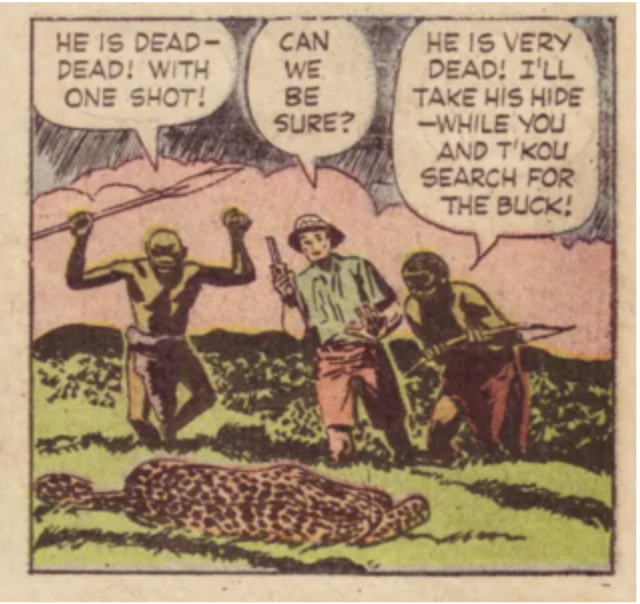
We are shocked by the presence of other life. They sprout from crevices like caveflowers. The compositions seem to clench up when the creatures are present, the perspective breaks apart, as eyes squinting at prey. We want to be there with these creatures, not to alarm them, even as we know our being here is poison to them, and forces their retreat into the plum blossom’s darkness. Incidentally, that Harunobu print inspired an imagist verse by the poet Ezra Pound:
The apparition of these faces in the crowd
Petals on a wet black bough
Pound expresses the composition in all its hidden ghastliness. The white petals become eerie miracles from a branch amputated by darkness.
The image rings true not only for “Plum Blossoms,” but for Marsh. When Jon shoots one of these lost leopards, the corpse is flattened on the plains. His linework is so lacking in definition, it borders on the grotesque. It’s difficult to imagine the skin hanging drearily over the earth as ever having harbored life. One wonders how the “black bough” could have ever kept those petals alive, how anything could ever live there again.
The post The Vanishing Herds: Jesse Marsh’s Tarzan Revisited appeared first on The Comics Journal.


 Hello, my name is Jack Sparrow. I'm a 50 year old self-employed Pirate from the Caribbean.
No comments:
Post a Comment